
The Moral and Intellectual Criminality of Artificial Intelligence
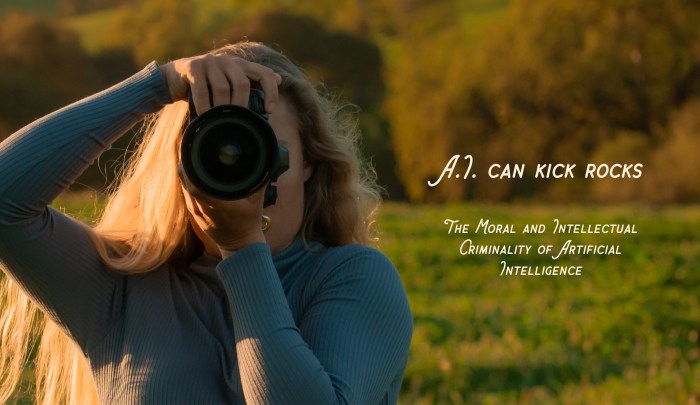
Photography walks a fine line between a trade and an art form, reliant upon both an artist’s eye and the skill to execute the resulting vision. It is both objective and subjective, value based on both quality and individual taste. Most importantly, however, as with both a trade and an art form, it is innately human. In my opinion, which is entirely what this essay speaks to, good photography is always human.
The depth and meaning in all art is felt most profoundly because of the implication of human creation. This principle is applicable to more than just photography, for it extends to illustration, writing, graphic design, film making, music, and countless other art forms. It is these methods of human expression that have stood for years as what I interpret to be visual proof of distinctly human emotion. More pointedly, it is the infringement of artificial intelligence on these practices that I find wildly unsettling. The removal of humans from human expression.
Artificial intelligence (A.I.) is frequently presented as “the future” and takes the form of an “inevitable” wave sweeping across the tech world. It pervades our current day-to-day experience in a way I can only describe as deeply disturbing. There was a time when A.I. was characterized as a Terminator type figure, something like Hal 9000 from 2001: A Space Odyssey. It was distant, futuristic, and dwelled only in the pages of science fiction novels. Now, it has reared its ugly head as something much worse, if that’s even possible. Now, it and those who benefit from its effectiveness seek to replace cognitive function.
Your parent’s friends use it to put together grocery lists, your co-workers use it to write emails, your local business uses it to revamp their perfectly good logo and replace it with one that aggressively looks like it was spat out by ChatGPT. The fact of the matter is that A.I. is incapable of original thought. It is trained upon existing material. Whatever mess it spits out, is not a profound creation, but a hodgepodge of essentially plagiarized source material it presents as something made for your benefit. A.I. draws upon available human creativity and originality, blends it haphazardly and feeds it in bitesize dinosaur shaped chicken nuggets to people seemingly too lazy to muster an original thought of their own.
From an intellectual standpoint, it’s concerning to say the least. Utilizing A.I. for undertakings requiring even the most modest cognitive stress is nothing less than intellectual sloth. I could leap onto and stop around on a Pentagon sized soap box about the literacy crisis and the disheartening state of the education system since the rise of A.I. usage. At the risk of posing an “walked to school in the snow, barefoot, uphill both ways” anecdote, I do in fact believe we lost something when we stopped writing essays, in class, by hand. However, that is a full research paper worth of educated ranting and if I’m being frank, I’m writing this from the comfort of my couch as a method of expressing frustration. That’s not to say I won’t get a bee in my bonnet one day, break out my stepladder, and ascend to that lofty soap box, but it won’t be today.
Today, I address the simple fact that it feels like an act of rebellion to refuse to intentionally utilize A.I. Not because I have an inherent need to stick it to the system or a strong-willed “I’m not like other photographers” complex, but because I believe in the simple value in authenticity. The heavy usage of A.I. to write social media captions, emails, website copy, marketing materials, and even books feels nauseatingly dystopian to me. It is not lost on me that writing does not come easy to some, in the same way that I subconsciously want to break out in hives wherever I remember those timed math quizzes from grade school. There’s a reason I didn’t enter a career field that requires me to do more than add groups of cows together or calculate how long to give myself between photo locations.
However, the best way I’ve heard it described is this: Why would anyone want to read what nobody could bother to write? The elements that make things valuable are time, effort, skill, and quality. With A.I., you hardly ever get one of those elements. So you’re not good at writing. Something you wrote poorly is always better than claiming something you didn’t write. And let’s be honest, if you’re using A.I., we both know you didn’t write it. That is something the tech world, or whatever cavernous pit keeps churning out these generative A.I. platforms, can’t seem to get a grasp on. Good writing is only good because there is honest-to-goodness human intention that is being expressed through wordcraft. Good social media captions only hit home when it feels like a real person wrote them. Why should anyone pay any mind to a business, to their website, if they clearly couldn’t pay it the mind to write their website copy themselves? And don’t kid yourselves. We can tell.
What I’m saying isn’t revolutionary. Hell, it isn’t even out of the box thinking. It’s just the frustrated musings of someone who has spent a large portion of their life placing value in truly good writing, photography, film, and design. There’s an exhaustion that comes with having a societal dynamic forced upon you and there’s a part of me that thinks people will grow tired of being lied to. Not everyone, mind you. Your neighbor will probably continue to use that ChatGPT generated cartoon profile photo of her and her two cats (you know, the one where she mysteriously has a third arm and somehow hasn’t noticed). However, I hope and I pray that there will reach a breaking point where the general population grows weary of the heedless deception and yearns for the authenticity of human connection again. The new version of the “getting back to nature” movement, if you will.
So go forth and create, and create honestly, I implore you. I assure you, even if what you create doesn’t live up to the standard in your head or even industry standard, the spark of human creation you poured into it makes it worth more than any menial A.I. generated pseudo-plagiaristic end result.

 J.K.F. Imagery